
Endemic Birds of the Colombian Andes: A Guide for Serious Birders

Updated: Jun 24
The Andes: a living engine of endemism
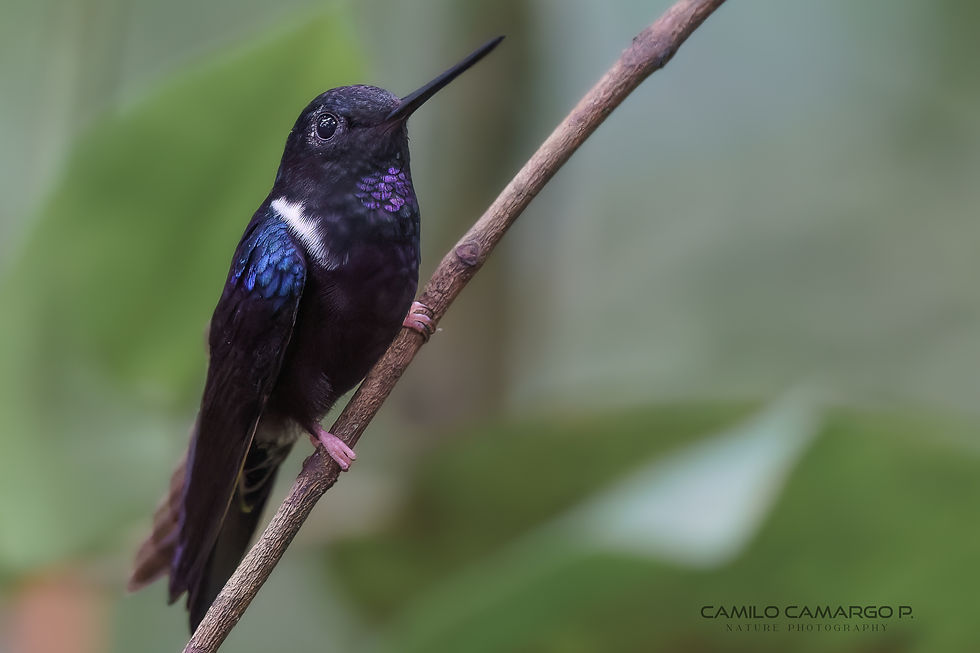
The Colombian Andes are one of the most important centers of bird endemism in the world. Shaped by millions of years of geological uplift, isolation, and climatic variation, these mountains have given rise to a remarkable number of bird species found nowhere else on Earth.
For serious birdwatchers, the Andes are not just a destination — they are a long-term field of study, where each valley and elevation band reveals a distinct evolutionary story.
What does “endemic” really mean?
In birdwatching, the term endemic is often used casually. Scientifically, however, it has a precise meaning.
An endemic bird species is one whose entire natural distribution is restricted to a specific geographic area. In the Colombian Andes, endemism is the result of:
● Mountain barriers isolating populations
● Deep valleys acting as biological borders
● Microclimates creating highly specialized habitats
● Long periods of evolutionary separation
Many Andean endemics occupy extremely narrow ranges — sometimes limited to a single slope, watershed, or altitude band.
Observing them is not about rarity alone; it is about understanding how landscapes shape life.
Why the Colombian Andes are uniquely rich in endemics
Several factors make the Colombian Andes exceptional even among mountain systems worldwide:
1. Three cordilleras, three evolutionary pathways
Unlike most Andean countries, Colombia’s Andes split into three separate mountain ranges: Western, Central, and Eastern. This fragmentation has multiplied opportunities for isolation and speciation.
2. Extreme altitudinal gradients
From lowland forests to páramos above 4,000 meters, birds have adapted to radically different ecological niches over short horizontal distances.
3. Climatic stability over evolutionary time
During past climatic fluctuations, Andean forests acted as refuges, allowing species to persist, diverge, and specialize.
The result is a mosaic of endemic species tightly linked to specific elevations and habitats.

Where to find endemic birds in Colombian Andes
Endemic birds are not evenly distributed across the Colombian Andes. Some regions stand out due to their combination of habitat continuity and evolutionary history:
● Central Andes: cloud forests and highland ridges with dense concentrations of localized species
● Western Andes: humid forests influenced by Pacific moisture, rich in narrowly distributed endemics
● Eastern Andes: complex transitional zones between Andean and Amazonian ecosystems
In all cases, access and observation require careful planning and deep local knowledge.
The challenges of observing endemic species
Endemic birds are often among the most difficult to observe.
Many exhibit:
● Low population densities
● Secretive or ground-dwelling behavior
● Limited daily activity windows
● Strong sensitivity to disturbance
Successful observation depends far more on:
● Habitat understanding
● Behavioral cues
● Vocal recognition than on chance or speed.
This is why endemic birding is best approached as a process, not a checklist exercise.
Ethics matter when ranges are small
When a species exists only in a restricted area, every interaction matters.
Responsible observation of Andean endemics requires:
● Respectful distances
● Minimal or no use of playback
● Small group sizes
● Patience rather than pressure
Ethical field practices are not optional in these environments — they are essent.
Endemics and the value of time in the field
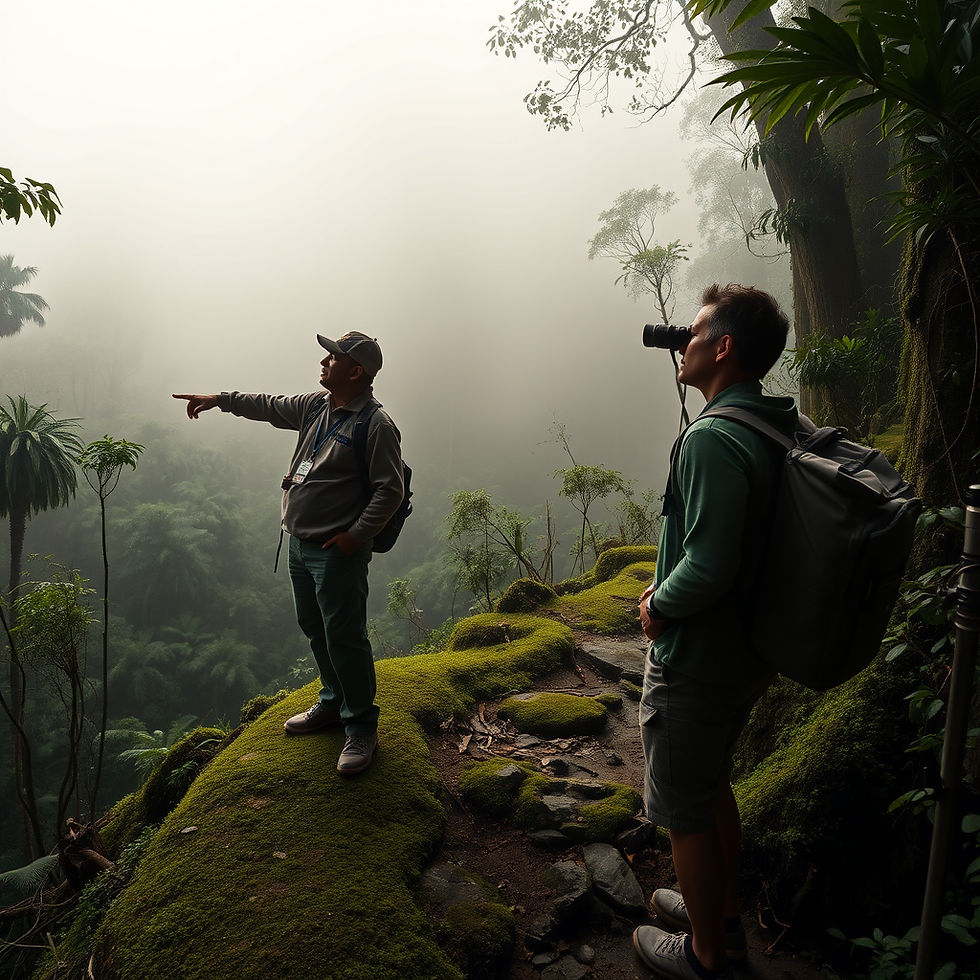
Unlike widespread species, endemics often reveal themselves only after sustained presence in their habitat. Weather, light, and daily rhythms play a decisive role.
This is why Andean endemic birdwatching rewards:
● Multi-day exploration
● Repeated visits to the same sites
● Attentive listening as much as visual scanning
Time in the field is not a luxury here; it is the primary tool.
Why Andean endemics matter beyond birdwatching
Endemic birds are indicators of ecosystem health. Protecting their habitats safeguards entire ecological communities — from plants and insects to water systems and human livelihoods.
For birdwatchers, observing Andean endemics is not only a personal achievement. It is a direct encounter with the responsibility of conservation in one of the planet’s most fragile and irreplaceable regions.
Exploring the Andes with intention
At Faunaris, our Andean expeditions are designed around the realities of endemic bird observation: time, elevation, ethics, and scientific understanding.
We prioritize:
● Habitat integrity over speed
● Observation quality over species counts
● Learning over guarantees
If you are interested in exploring the Colombian Andes with depth and respect, we invite you to discover our approach.
👉 Discover Andean Expeditions


Comments