
What the October Big Day Really Counts: Lessons from a Day Beside Tamá National Park

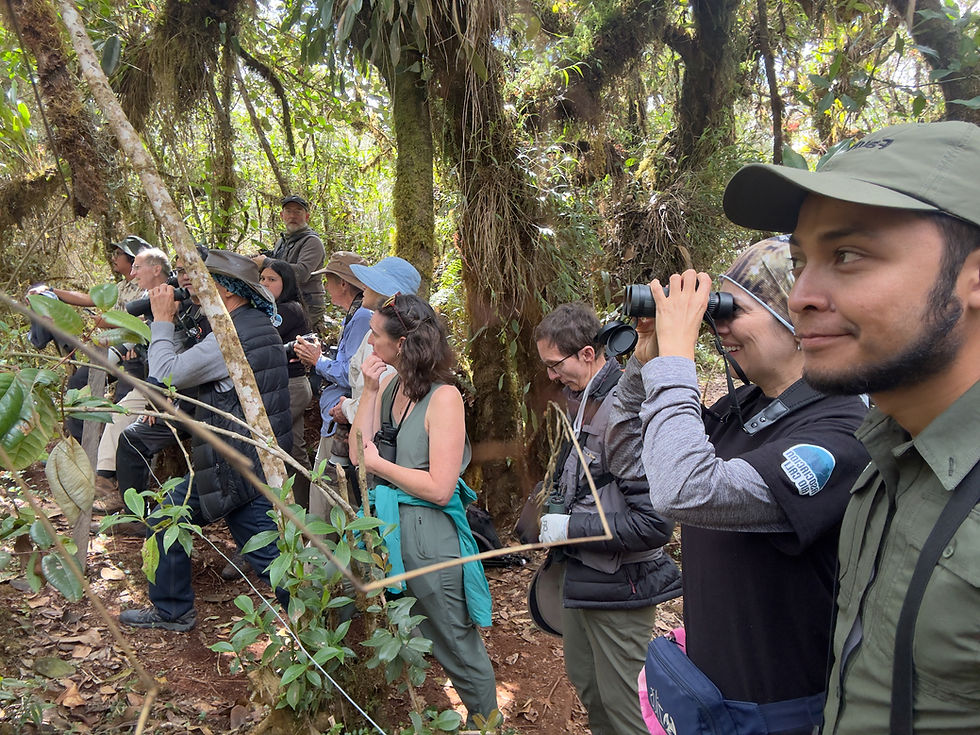
At 5:03 a.m. on October 10, our first checklist of the day held two species, and we did not see either one. A Band-winged Nightjar and a Tropical Screech-Owl called from the dark near the cabins of the Orocué sector, in Tamá National Park on the Colombia–Venezuela border, which the park's own sign places at 2,450 meters above sea level. We logged both as heard-only. Twenty minutes, two birds. By dusk our team had filed 14 checklists, walking with national park rangers who all come from the area. One short stretch of the day took us across the border into Venezuela; 79 of our species were recorded on the Colombian side.
That quiet routine of noting what is there, how long you looked and how far you walked is what the October Big Day is made of. Colombia turned out in large numbers this year. Here is what the numbers mean, and what they don't.

What a Big Day actually is
A Big Day is 24 hours in which birders try to record as many species as they can. The October edition complements the Global Big Day held in May, and it does not require expertise: records can come from nature reserves, trails or even a window at home. Everything is submitted as eBird checklists, the platform run by the Cornell Lab of Ornithology.
Colombia's 2026 numbers, in context
Colombia took first place worldwide at the 2026 October Big Day with 1,469 species, from 8,164 shared checklists and 2,604 observers. A year earlier, Colombia also led, with 1,339 species, from 5,153 checklists and 1,775 observers. That is 130 more species, and by our arithmetic roughly 58% more checklists and 47% more observers. In May, the Global Big Day put Colombia at 1,566 species in a single day.
This is a pattern, not a fluke. Colombia has led most editions of the Big Days since 2017; Brazil won in October 2019 and Peru in May 2021. In May 2026, Peru came second with 1,438 species, followed by Brazil (1,204), Ecuador (1,068) and Venezuela (890), so the lead over the runner-up was well over a hundred species. Leading most of the time, against the other great birding countries of South America, points to something structural, not luck.
For scale, Colombia has 1,954 bird species according to its national biodiversity information system, around 82 of them endemic and roughly 150 to 160 northern (boreal) migrants. A single Big Day records roughly three of every four of the country's species. It is an approximation, not an exact figure, but this year's 1,469 species is consistent with it.
What a count measures, and what it doesn't
A national total is two things multiplied: how many species exist, and how many people went looking. The first is nature. The second is us. Colombia's lead reflects real diversity, but more observers in more places also produce more records. In 2026, 2,604 observers filed 8,164 checklists, an average of just over three each, which says as much about effort as about birds. A ranking is a headline, not a health check.
Counts also say what was recorded, not what is declining. A species can be missing from a list because it is scarce, or because nobody stood in the right forest at the right hour.
Why the data still matter
Cornell's eBird Status and Trends project turns raw sightings into estimates of distribution, abundance and population trends over time. A 2025 study described how conservation organizations are using birdwatcher data to pinpoint opportunities to reverse population declines.
Cornell is open about the limits: citizen-science data carries biases, such as uneven coverage and observers of very different skill, which its statistical methods have to account for. That is why the unglamorous details on each checklist, such as start time, duration, distance and whether we heard or saw a bird, are not bureaucracy. They are what allows a day like this to be used later.
What our day looked like
Our trip report covers Tamá and its surroundings: 14 checklists and 86 species in total, 79 of them on the Colombian side. One short checklist came from just across the border in Venezuela. The individual lists say more than the total.
How the day unfolded. The first two checklists were short and quiet: two species heard in the dark at 6:03, then six in 15 minutes on the trail at 6:24. By 8:21 the trail lists were still giving nine species in 35 minutes. At 9:00 we stood still for 38 minutes and recorded four species, among them a male and a female Lazuline Sabrewing. The richest forest list, 16 species in 36 minutes, came at 10:27. In the afternoon the pace changed: nine species at 2:25 p.m., then, in open country at the end of the day, 22 species at 4:53 p.m. and 25 at 6:12 p.m.
The richest lists were not the best birding. Two checklists in open, settled country, one near Herrán and one just across the border, logged 25 species in 15 minutes and 22 in 16: Tropical Kingbirds, Great Kiskadees, Saffron Finches, Rufous-collared Sparrows. On the Sendero del Arenal, in forest, our lists ran between roughly 10 and 27 species per hour; in open country they ran 80 to 100. Those forest lists were short, slow walks of between 130 and 290 meters. The forest delivered less in numbers and more in quality.

The specialists came one list at a time. The Muisca Antpitta and the Pale-bellied Tapaculo, both endemic to Colombia, each appeared on a single checklist, the tapaculo was logged as an audio record and our group only heard the antpitta. The Chestnut-breasted Chlorophonia also appeared on a single list, seen in a mixed flock; it is rarely seen well because it lives almost always in the canopy.

Ears did a lot of the work. At least four species on our lists were recorded by ear only: the nightjar, the screech-owl, the tapaculo and a Spectacled Tyrannulet. A good guide's hearing is part of the data.
Two families carried the day. Ten of our 79 species were hummingbirds: Lesser Violetear, Longuemare's Sunangel, Long-tailed Sylph, Tyrian Metaltail, Collared Inca, Blue-throated Starfrontlet, White-booted Racket-tail, Rufous-shafted Woodstar, Lazuline Sabrewing and Green-bellied Hummingbird. Another 13 were tyrant flycatchers (the family Tyrannidae). Together, those two families made up 23 of the 79 species, nearly three in ten. A day like this is built less on one glamorous bird than on the quiet abundance of a few large families. The Green-bellied Hummingbird on this page's cover was photographed in Herrán on October 9, the day before the count; the species itself was on our October 10 Herrán checklist, with three individuals.
Migrants were a small minority. Only two of the 79 species we recorded in Colombia, the Blackburnian Warbler and the Summer Tanager, are northern migrants. Nationally, northern migrants are about 8% of the species list (roughly 150 to 160 of 1,954; counts vary by source and definition). They arrive between roughly September and October and leave between late February and May. Northern migrants arrive between roughly September and October and stay until April or May, so an October day catches only the start of their season. Our count is a snapshot, not a verdict.
Our own data have the same limits we described above. It was one day, one group and one stretch of the border country around Tamá National Park. It cannot tell us whether a species is increasing or declining. What it can do is show what a careful field day looks like in this part of the country, and how little of any national total one team can ever see. Every figure in this article comes from our checklists, which record time, duration and distance, or from published national totals.
Tamá National Park is closed to the public, so this is not a trip anyone can book, and not one we could sell. We were there as a field team, with permission from Parques Nacionales Naturales, to contribute data and to learn, alongside rangers from the area. Places like this are birded well when local people lead. For more on that model, see our piece on [community-based birdwatching in Colombia].

What this means if you are planning a trip
Colombia's headline number can mislead a traveler. Nobody sees a national total. Our team, covering several habitats from dawn to dusk, recorded roughly 5% of what the whole country logged that day. That was a good day, not a modest one.
So read the rankings as proof of diversity, not as a promise. Choose your season and region by the habitats and target species you care about, and treat migrants as a welcome layer on top, not the reason to book. Because northern migrants are in Colombia from about September–October, with departures running from late February into May, a trip in that window can overlap with them, but the habitats you visit decide what you see. We will cover the seasonal calendar in a dedicated guide.
How to make your own checklist count
Record your start time and how long you watched. Note the distance if you are walking. Say honestly whether you heard or saw each bird. Leave out what you are not sure of, and use an "X" when you cannot count. Share the list with your group so the same birds are not entered twice.
Planning a 2027 or 2028 expedition?
Tell us your dates and which Andean habitats you most want to see. We will tell you honestly what that season can and cannot offer, and we will never promise a species list. Explore the [Andes Life List Expedition] or [write to us].

Comments